







EXPERTISE
Product Management
Is your product strategy struggling to translate into tangible results? Are you having trouble managing your current products? We help your teams structure their vision, prioritize the right initiatives, and manage execution systematically—from strategy to product launch.
The finding
Many product teams operate without a clear vision, without a dedicated product manager, with roadmaps that are disconnected from business priorities, or with delivery cycles that are getting longer due to a lack of rigorous prioritization. The result: investments that struggle to create value and teams that lose focus and motivation. This is precisely where our Product Management Practice and the role of product manager or owner come in: to provide you with a roadmap and help you establish a sustainable product culture.
Our support
Our experts (product managers or product owners) quickly integrate into our clients’ teams to understand their challenges before proposing solutions. We are involved throughout the entire product lifecycle—from defining the vision to managing delivery—by providing the methods and best practices that make a difference in managing your product.
What we solve
Is your product vision unclear or not well communicated to the teams?
Together, we develop a clear vision—aligned with your business objectives—that actually works, and we embed it within the organization.
Is it difficult to prioritize and defend your roadmap internally?
We structure your discovery and prioritization process so that every decision is well-founded and clear.
Is your delivery service lacking in consistency or predictability?
We implement the routines, metrics, and processes that make your operations run more smoothly and reliably, ensuring the successful delivery of your products.
Our professions
Product Manager
Product Ops
Product Coach
Agile Coach
Our expertise
Product strategy
Product Vision
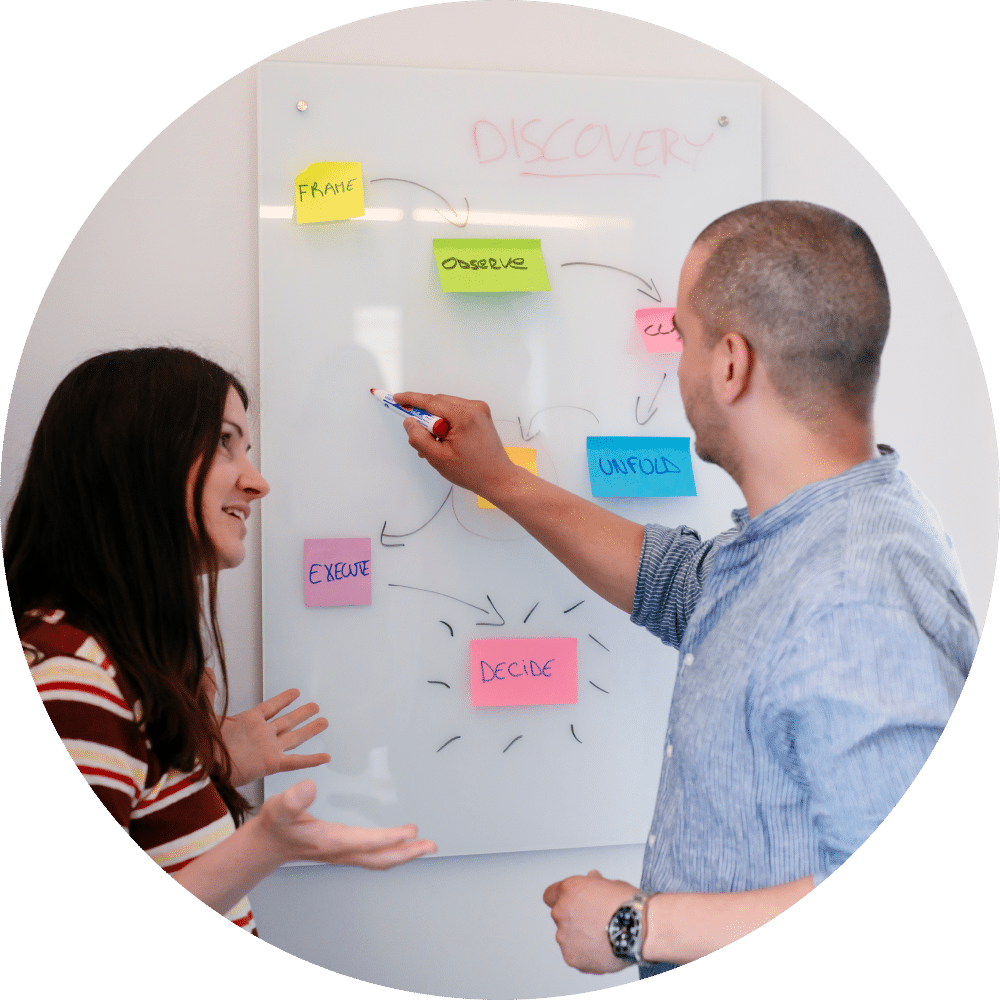
Discovery
Delivery
OKR
Prioritization
Agile rituals
Examples of assignments
As part of the management team of an e-commerce site for electronics and household appliances, a consultant was called in to improve the purchasing and post-purchasing customer experience. Analysis of sales KPIs, NPS, customer service activities and user feedback to define a strategy and roadmap, and proposal of a Discovery methodology.
Working for a customer in the supply chain sector, our team, comprising two Product Managers and a Product Designer, was dedicated to the delivery and discovery of their applications. Our intervention was also aimed at guiding the customer towards a more product-centric approach (frequent delivery, OKR, product vision, design process, post-implementation follow-up).
As part of the Product teams of a player in the sports betting industry, our Product Manager leads a multi-profile team: Tech, QA, Design. He is involved in identifying and prioritizing Product initiatives in the context of the creation of a new Offers platform. He leads the Delivery activity in an environment with strong dependencies between Product squads.
In an agritech startup developing autonomous robots, our Product Manager structured the Product organization to support its ramp-up. The mission began with a co-constructed 3-5-year product vision, which was then translated with the teams. A diagnosis of 20 key themes enabled us to measure product maturity and prioritize 33 concrete recommendations. The intervention laid down the fundamentals: clarification of roles, adoption of OKRs, Definition of Done, framing of tests, structuring of rituals. The result: faster decisions, better coordination, smoother development cycles and enhanced performance.
As part of the digital department of France's leading radio group, our Product Management consultant oversaw the design, implementation and roll-out of a new program schedule management tool for all the group's channels. The mission began with an in-depth Discovery phase (user interviews, benchmarking of other media practices, "make or buy" arbitration), and continued with the definition of a clear Product vision, the elaboration of a structured roadmap, the delivery of an operational MVP, and then the progressive roll-out to each channel.
Within the digital department of France's leading radio group, a consultant led the design, implementation, and rollout of a new program schedule management tool for all of the group's channels. The project began with an in-depth discovery phase (user interviews, benchmarking of other media practices, "make or buy" decision-making), followed by the definition of a clear product vision, the development of a structured roadmap, the delivery of an operational MVP, and then gradual deployment across each channel.
How we work
Our Product Managers are involved throughout the entire product lifecycle. Depending on your context, the scope of work may cover just one of these stages or all of them—from discovery through development to delivery. We always begin by gaining a deep understanding of your context, your product, and your current practices before making any recommendations. There’s no one-size-fits-all testing strategy: each approach is tailored to your risks, your tech stack, and your goals. From strategy to execution, we remain fully committed at every step.
Do you have a Product Management project?
APPROACH 1
Staffing
A product manager or product owner integrated into your product teams to provide targeted expertise and support your business and marketing goals.
APPROACH 2
Consulting
Support from one or more product management experts on a strategic or operational issue.
APPROACH 3
Customized workshop / training
A customized workshop lasting from half a day to 3 days to solve a product-related issue, generate ideas, help develop in-house skills, or raise awareness among your teams on a specific topic.
Our Practice Leaders
Marion
Paris
Yoann
Toulouse
Hussein
Toulouse
Paris
Toulouse
Bordeaux
"I had the ambition to have an impact in the development of a Product structure and 5 Degrés offered me this opportunity."
Florian, Practice Leader Product Management
"I chose to join 5 Degrés because of its vision of Product Management and its desire to transform companies from the inside."
Frédéric, Product Manager
Product Management: A strategic and user-centered
At 5 Degrés, product management is much more than just a methodology: it’s a culture we embody every day through our product strategy, our cross-functional collaboration, and the tangible value we deliver to you.
Product Management creates impact and brings meaning not only to your products, but also to your teams and users. By prioritizing user experience, continuous iteration, data analysis, and experimentation, our consultants design solutions that precisely meet your needs while aligning your marketing goals with your technical constraints.
A clear product vision aligned with your business needs
Building a solid product vision rests on three inseparable pillars:
Business Challenges
align your product roadmap with your strategic objectives and key results (OKRs).
User needs
gain a deep understanding of their expectations in order to create products that solve their problems.
Technical ambitions and constraints
Leverage technological opportunities while respecting your resources and your ecosystem.
A strong product culture transforms your organization: it breaks down silos, drives organizational transformation, and fosters collective decision-making. Every team member becomes a champion of the product vision, ensuring consistent and impactful product execution.
Evolving the organization, not just the product
Adopting an effective product strategy requires rethinking your internal processes. Your tools, methods, and workflows must be aligned with a culture of continuous improvement, inspired by Agile and Lean principles.
At 5 Degrés, we support this transition so that your organization can become more responsive, more collaborative, and more focused on creating value. This allows your organization to evolve in step with your users, while optimizing your overall performance.
Toward Responsible and Sustainable Product Management
Digital products must address the human, economic, and environmental challenges of our time. Incorporating their long-term impact from the design phase and knowing how to manage it is essential to ensuring their effectiveness and relevance.
Our approach to responsible product management always includes:
Product Accessibility
inclusive solutions tailored to all users
Eco-design
a reduction in the environmental footprint, from the design phase through to deployment.
Digital minimalism
optimized products, without unnecessary frills.
This sustainable approach aims to create products that are not only useful today, but also durable and aligned with the expectations of tomorrow.
FAQ - Product Management
The Product Manager is responsible for the “why” and the “what”: vision, understanding of the market and users, and roadmap decisions, in collaboration with marketing and business teams. The Product Owner is responsible for translating these concepts into operational terms for the development team: the backlog, user stories, and acceptance criteria. In small companies, a single person often fills both roles. In larger organizations, several Product Owners may work alongside a single Product Manager.
By making the decision-making criteria explicit. A roadmap is sound when each element is linked to a measurable objective—typically formalized as an OKR—and evaluated based on expected value, development effort, and the level of uncertainty. Usage data and user feedback help objectify these trade-offs. What hinders prioritization is almost never a lack of tools, but rather a lack of shared objectives between managers and company leadership.
Discovery comes before development: its purpose is to confirm that a problem exists, that it’s worth solving, and that the proposed solution addresses it. It involves user interviews, analysis of usage data, market benchmarking, “make or buy” decisions, and testable prototypes. The goal: to avoid starting development on a feature that no one will use. Product Managers conduct it on an ongoing basis, not just at the start of a project.
A KPI continuously measures a metric or performance: conversion rate, turnaround time, or NPS for customer experience. An OKR sets a goal for progress over a given period, with a qualitative objective linked to key quantitative results. The two complement each other and draw on the same data: KPIs describe the current situation, while OKRs indicate what the team is aiming to achieve. It is the combination of these two metrics that helps managers make strategic decisions to guide the project.
Both approaches address different needs. A consultant brings immediately applicable experience: ensuring continuity during an absence, handling a surge in activity, providing guidance for a project launch, or implementing practices that the team will then take over. Hiring is necessary for a permanent role on a core product. A consulting engagement often helps the company define the skills expected of the Product Manager to be hired.
The initial effects—clarified roles, established routines, and faster decision-making—become apparent within a few months. Sustainable embedding takes place over a longer timeframe, as it requires that trade-offs, objectives, and collaboration methods evolve beyond the Product team to include business functions, marketing, and company leadership. A maturity assessment helps gauge the starting point and track progress toward establishing a sustainable product culture. This is the goal of the product manager’s role.
Lorem ipsum
Team reinforcement is ideal when you’re missing a Product Manager or a specific skill set over the long term: the consultant integrates into your teams and your workflows. Consulting addresses a specific challenge, such as defining a product vision or structuring a roadmap, led by one or more experts. A customized workshop or training session—ranging from half a day to three days—helps resolve a specific issue or build the skills of the Product Manager and Product Owner, for example, in OKRs or discovery.
Lorem ipsum
These are three roles that complement that of a Product Manager. The Product Ops role equips Product Managers with processes, tools, performance metrics, and the sharing of best practices across teams. The Product Coach helps teams build their skills in vision, discovery, and prioritization. The Agile Coach focuses on the development team’s rituals and delivery cadence. Which role to bring in depends on what is currently holding your organization back.
Latest news in Product Management
Expert articles, interviews, experience feedback and recaps of our exciting in-house events and projects.