
Data Agency in Toulouse
Leverage Your Industrial and Embedded Data
Enormous volumes of data from sensors and onboard systems, along with traceability and safety requirements that leave no room for approximation

Toulouse’s data challenges are unique, and architectures designed for transactional data do not address them. Based since 2021 at 8 Grande rue de Nazareth, in the Carmes neighborhood, we support the region’s industrial and technology players on these issues.
Data engineering, data science, AI, and data analysis. Our consultants work alongside your teams, supported by our Practices and the group’s 150 employees.


Why hire a data agency based in Toulouse ?
Toulouse is the European capital of the aerospace industry. This specialization gives rise to data challenges not found in either Paris or Bordeaux. The issues we most frequently address in the Toulouse metropolitan area are structural in nature, and they recur across different clients.
Having been based in the Carmes neighborhood since 2021 allows us to be present with our clients throughout the metropolitan area—from Blagnac to Labège, including the Oncopole healthcare hub—with a consistency that remote management simply cannot provide. This also enables us to bring your systems, data, and business teams—which often operate in silos—together to work collaboratively.
Your data comes from test benches and sensors, not from a CRM
Your time series data are driving up your storage costs
Your traceability must cover a life cycle spanning several decades
Your incidents are too infrequent for a standard predictive model
Your environments are isolated, and your security requirements are non-negotiable
The 5 Degrés solution: These constraints are incorporated right from the architectural design phase, rather than being treated as a last-minute adjustment.
Your health data requires sensitivity, reproducibility, and volume measurement
Your field data remains on the machines
The data doesn’t come from a CRM or an e-commerce site: it comes from test benches, flight telemetry, instrumented production lines, and satellite constellations. It arrives as a continuous stream, in proprietary formats, with data volumes that overwhelm architectures designed for transactional data.
The 5 Degrés solution: ingestion pipelines designed for these formats and data rates, and industrial data modeling that speaks the language of your business entities rather than that of a traditional data warehouse to consolidate all the information.
How to ingest and archive very high-frequency time series without driving storage costs through the roof. The issue is as much economic as it is technical: at these acquisition frequencies, infrastructure costs quickly become the project’s largest expense.
The 5 Degrés solution: a storage strategy tailored to the frequency and retention period, well-defined aggregation and sampling strategies, and a decoupling of the real-time ingestion pipeline from the exploration pipeline.
How can we ensure the traceability of data over a product lifecycle that spans decades? Formats evolve, tools change, teams come and go, yet the data must remain readable and verifiable long after those who produced it have left.
The 5 Degrés solution: documented data governance from the design phase onward, traceable architectural choices, and quality control throughout the entire lifecycle—not just at the outset.
How to build actionable predictive maintenance for a fleet where each incident is rare and the cost of a false negative is disproportionately high. Added to this is a requirement for explainability: in both the aerospace and healthcare industries, a result that cannot be explained has no operational value.
The 5 Degrés solution: anomaly detection approaches tailored to rare events, thresholds set in consultation with your teams based on the actual cost of the error, and models designed to be auditable.
Added to this is a constraint imposed by the industry—one we know well—namely, the need for controlled environments. Cybersecurity, sovereignty, regulatory requirements, and perimeter segmentation. The data architectures we design must be high-performing while remaining compatible with these frameworks, which immediately rules out a number of solutions on the market.
The 5 Degrés solution: these constraints are integrated right from the architecture definition phase, rather than being treated as a last-minute adjustment.
Healthcare is our second major focus area in Toulouse, with a dense pharmaceutical and clinical research ecosystem centered around the metropolitan area, and challenges similar to those faced by the industry: sensitive data, reproducibility requirements, and high data volumes.
The 5 Degrés solution: reproducible and documented processing workflows, and a system for managing sensitive information designed to withstand a regulatory audit.
Finally, agri-tech and regional industry are entrusting us with projects involving the implementation of tools and the utilization of field data. Sensors are installed, data is collected, but it never reaches the people who could use it to make decisions.
The 5 Degrés solution: a complete workflow from instrumentation to reporting, with management tools that integrate seamlessly into your teams’ existing workflows rather than operating separately from them.
Our data expertise in Toulouse
Data Science & AI
Data Engineering
Data Analysis
Predictive maintenance, anomaly detection in rare events, optimization of industrial processes, and the application of AI to technical and documentary datasets. Our models are designed to be auditable: in both the aerospace and healthcare industries, a result that cannot be explained has no operational value.
This is the core of our operations in Toulouse. Time-series architectures, sensor data ingestion, resilient pipelines, industrial data modeling, and quality and traceability throughout the entire lifecycle. We build foundations designed to handle large volumes of data and stand the test of time, in environments where reliability takes precedence over speed of implementation.
Production, quality, and industrial performance metrics, reported to both field teams and management. We design management systems that integrate into your teams’ existing routines rather than operating separately from them.
Where to start: Our input formats
- Maturity Assessment: A structured analysis of your product and data organization, including prioritized areas for improvement. Particularly relevant for industrial organizations where data, systems, and business teams operate in silos.
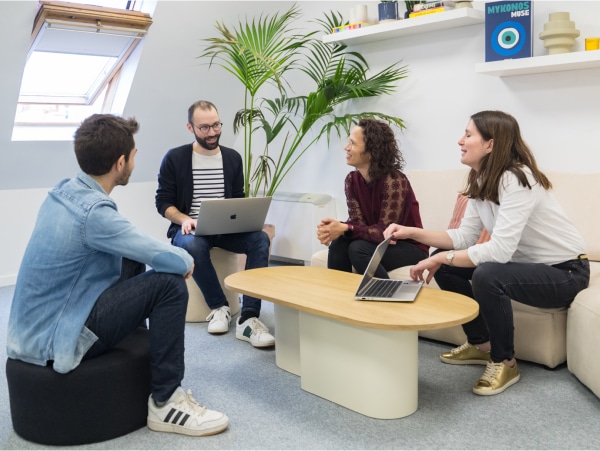
- Workshops: ranging from half a day to three days, held at our Carmes office or at your location: technical scoping of an architecture, data and AI literacy, and alignment between systems and data teams.
- Accessibility Audit: For your digital products subject to regulatory requirements, a structured, solution-oriented audit.

The sectors we support in Occitanie
- Aeronautics and MRO: Test Data, Telemetry, Predictive Maintenance, Traceability
- Space and Embedded Systems: Data Stream Processing, Constellation Data, Volumetry
- Healthcare, Pharmaceuticals, and Clinical Research: Reliability, Reproducibility, and Sensitive Information
- Industry and Manufacturing: Instrumentation, Quality, Production Performance
- Agri-tech and the Agri-Food Industry: Field Data, Sensors, Decision Support
- Transportation and Mobility: Utilizing Usage and Infrastructure Data

The data team at our Toulouse office
Our Toulouse team, which opened in 2021, consists of 20 consultants, a significant number of whom are part of the Data Practice—a team composition directly aligned with the nature of projects in the Toulouse region. Our Toulouse-based consultants have a dual background in data and systems, which enables them to collaborate with your engineering teams on their own terms.
Our Practice Leaders lead expert communities, facilitate skill development, and provide support during the most technical scoping phases. A 5 Degrés consultant always has the option to draw on this community.
Meet us in Toulouse


- Directions: Carmes subway station (Line B) and Esquirol subway station (Line A), a few minutes' walk from the Capitole
- Service area: Toulouse Métropole, Haute-Garonne (31), and the entire Occitanie region (Blagnac, Labège, Montpellier, Tarbes, Albi, Castres).
- Our offices are nestled in the historic Carmes neighborhood, in the heart of the "Pink City," with direct access to both metro lines.
Frequently Asked Questions
Do you work with companies in the aerospace industry?
Yes, it’s a significant part of our operations in Toulouse. Our consultants are familiar with the industry’s requirements: traceability, isolated environments, lengthy validation cycles, and rigorous documentation of architectural decisions.
Can your consultants work in an environment with strict security requirements?
Yes. Some of our projects take place in environments subject to cybersecurity and data sovereignty requirements. These constraints are incorporated from the very beginning of the architectural design process, rather than being treated as a last-minute adjustment.
How do you handle very large volumes of sensor data?
Through architectures designed for time series: selecting storage solutions tailored to frequency and retention periods, aggregation and sampling strategies, and decoupling the real-time ingestion pipeline from the exploration pipeline. The issue is as much economic as it is technical—keeping storage costs under control is part of the overall framework.
Our incidents are very rare: Is a predictive maintenance model even possible?
Yes, provided we don’t treat the issue as a traditional classification problem. We use anomaly detection rather than learning from historical incident data, and we work with your teams to set thresholds based on the actual cost of a false positive and a false negative—which are never symmetrical.
Yes. In addition to the Toulouse metropolitan area, our consultants regularly work in Montpellier, Tarbes, Albi, and Castres. The frequency of on-site visits is determined at the start of the assignment.
Can you support our engineering teams who aren't data specialists?
This is a very common scenario, and one of our areas of expertise. Our data and AI onboarding workshops are designed for non-data technical teams: we start with your business objects and your actual data, not generic examples.