

In an environment where time-to-market and validation through use are key to success, the Lean Canvas Model has established itself as one of the go-to tools for product managers and entrepreneurs. Unlike exhaustive business plans, it allows you to frame your product strategy while accepting uncertainty.
Filling out a Lean Canvas is not a writing exercise, but a process of product discovery. This article provides a step-by-step guide on how to fill out a Lean Canvas and turn your intuitions into testable hypotheses.
What is Lean Canvas and what is it really for?
The Lean Canvas Model is a template for modeling business model condensed onto a single page. Its purpose is to enable entrepreneurs and product teams to break down their vision into basic building blocks in order to test its viability and identify areas of risk.
Definition and origin
Adapted from Alexander Osterwalder's Business Model Canvas by Alexander Osterwalder, the Lean Canvas was designed by Ash Maurya, author of Running Lean. Designed to integrate seamlessly with the Lean Startup framework Lean Startup, Lean Canvas is designed to reduce uncertainty by testing hypotheses in the field.
Lean Canvas vs. Business Model Canvas
The Business Model Canvas takes a more systemic and economic view of the business, while the Lean Canvas focuses more on product and market risks in the early stages to achieve Product Market Fit. This is the tipping point where your Product finally meets its demand and generates sustainable traction.
Features | Business Model Canvas (BMC) | Lean Canvas |
Focus | Key partnerships and resources | Problems, Solutions, Metrics |
Public | Established companies / Business Units | Startups and New Products |
Purpose | Business model optimization | Risk reduction and hypothesis validation |
When to use it (and when to avoid it)
- Use this: during the Discovery phase, to launch a new digital service, to pivot, or to define an MVP.
- To be avoided: for managing existing IT infrastructure without any change in usage, or for purely regulatory projects with no market implications.
In what order should you fill out a Lean Canvas?
Following a filling order ensures the logical consistency of the model and forces you to start from user needs rather than functionality.

- Step 1 – Customer segments (and Early Adopters)
- Step 2 – Problems (and existing alternatives)
- Step 3 – Unique Value Proposition (UVP) and your Pitch
- Step 4 – Solutions
- Step 5 – Channels
- Step 6 – Sources of income
- Step 7 – Cost structure
- Step 8 – Key Performance Indicators (KPIs)
- Step 9 – Competitive advantage
This order is recommended for a first draft, but in practice, the Lean Canvas is iterative. iterative and can be completed in a non-linear manner.
How to fill in each section of the Lean Canvas Lean Canvas (step-by-step)
Prerequisites & equipment
The exercise must be collaborative. Organize a Lean Canvas workshop bringing together:
- the Product Manager / Product Owner (who is responsible for the vision),
- a technical profile (CTO or Lead Dev) for feasibility,
- a Business/Marketing profile for traction.
Opt for a visual aid with a large format displayed on the wall with Post-it notes, or a digital board (Miro or FigJam) for remote teams.
Basic rules for filling out the Lean Canvas
Speed: you can fill a first draft in less than 20 minutes,
Clarification: one idea per Post-it note,
Objectivity: we distinguish what we know from what we assume.
1. Customer segments
Action: Identify precisely who is affected by the problem and target your early adopters.
Question: Who has the most urgent need?
2. Problems
Action: List the three priority issues and their current alternatives (manual processes, Excel files, repurposed tools).
Question: How do your users manage without you today?
3. Unique Value Proposition (UVP)
Action: Make a clear promise: [Benefit] for [Target] via [Solution].
Question: Why does your solution deserve attention?
4. Solutions
Action: Define the 3 key features of the MVP that address the problems listed.
Question: What is the bare minimum needed to add value?
5. Channels
Action: Determine how to reach your customers (direct sales, advertising, content, partnerships).
Question: How will customers discover you?
6. Key performance indicators (KPIs)
Action: Choose success metrics related to usage (activation rate, retention) and not just marketing performance. In the very early stages, certain KPIs can measure intention or proxy behaviorbefore actual usage.
Question: What action proves that the user finds value?
7. Competitive Advantage
Action: Isolate what cannot be copied or bought (exclusive data, rare expertise, community).
Question: What do you have that no one else can easily obtain?
8. Cost structure
Action: List major expenses (development, marketing/CAC, hosting, salaries).
Question: How much does it cost to launch and operate the product?
9. Sources of income
Action: Define your revenue model (subscription, commission, license).
Question: How and how much will your customers pay?
Validate and iterate: from Canvas to experimentation
The Lean Canvas is not a fixed plan, but a starting point where each block must be tested against market reality.
Identify the riskiest assumptions (Riskiest Assumption Test)
Look at your Lean Canvas: which box, if proven false, would cause the entire project to collapse? Generally, it is the combination of Problem/Customer Segment. This is the point that needs to be validated first.
Transform the Canvas into a Test Backlog
For each uncertain block, create an experiment (cycle Build-Measure-Learn):
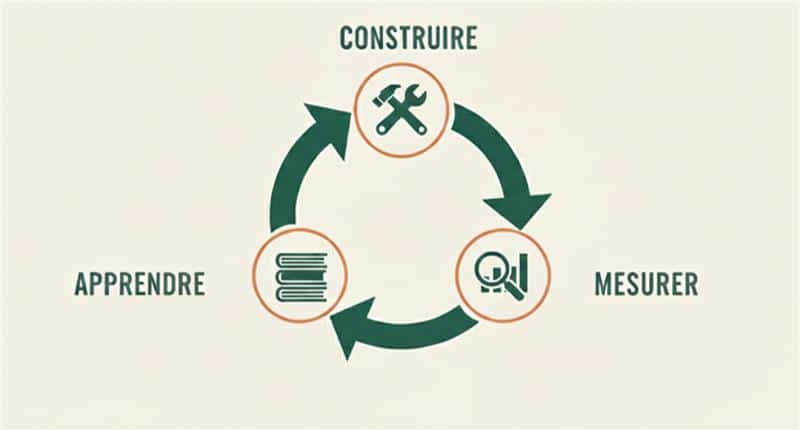
- Hypothesis: Customers are willing to pay $5/month for this service.
- Market testing: Create a landing page with a "See prices" button and measure the click-through rate.
Update the Lean Canvas
The Lean Canvas is a living document. After each phase of Product Discovery or testing phase, revisit the document. Cross out anything that is contradicted by evidence from the field, and validate anything that has been proven.
Example: Airbnb's Lean Canvas from Airbnb
In the early days, the founders of Airbnb realized that bookings were not taking off because of the poor quality of the photos. They went to photograph the apartments in New York themselves. This field test validated the hypothesis that the credibility of the offer depended on the quality of the visuals.
Here is a plausible reconstruction of Airbnb's Lean Canvas in their early days:
- Problems: High hotel prices; isolation of travelers; lack of additional income for individuals.
- Customer segments: Budget travelers; participants in crowded conferences (e.g., IDSA San Francisco). Early adopters: designers traveling for professional events.
- UVP (Unique Value Proposition): "Live like a local for a fraction of the price of a hotel."
- Solutions: Networking platform; secure payment system; professional photos (key pivot).
- Channels: Wild integration on Craigslist; word of mouth in tech communities.
- Revenue: 10% commission on each transaction.
- Costs: Technical maintenance; customer dispute management.
- KPIs: Number of nights booked; number of active listings.
- Competitive advantage (Unfair Advantage): Initially almost non-existent, it subsequently became a massive "network effect" (more hosts attract more travelers).
Examples & anti-patterns: what we often see and how to correct them
Common errors | Why is this a problem? | How to correct (Action & Example)? |
Target too broad | You can't please everyone with an MVP. | Reduce to the segment that is "suffering" the most. Example: "Artisan bakeries without an online store" instead of "Retailers." |
Confusing the problem with the absence of your solution | Your customer isn't buying a tool, they're buying a solution to a problem. By focusing on features, you're obscuring the real value that justifies the purchase. | Identify the real pain associated with the job. Example: "Invoicing time too long" instead of "No invoicing software." |
Blurred UVP | If your value proposition is not obvious, your product will be perceived as a generic solution with no specific appeal. | Use benefit-oriented language. Example: "Cut your billing time in half" instead of "Accounting workflow optimization solution." |
Vanity KPI | The number of likes doesn't pay the bills. | Measuring deep engagement. Example: "Retention rate D+30" instead of "Number of downloads." |
Frozen canvas | The Canvas becomes a forgotten document. | Update the Canvas during recurring meetings. Example: Annotate the Canvas after each Discovery phase. |
What you need to remember when filling out your Lean Canvas Model
- Always start with the problem before thinking about the solution.
- Identify your early adopters : those who suffer the most and are willing to test an imperfect version.
- Be specific : avoid vague terms such as "effective" or "fast."
- Distinguish between the buyer and the user in your segments.
- The UVP is not a slogan, it is a promise of value.
- Don't overlook the Unfair Advantage : it's your barrier to entry.
- Use Canvas to manage your tests and not as decoration.
- The Lean Canvas is a snapshot at a given moment. Accept that it will become blurred as you learn more.
The Lean Canvas is a product management tool that prioritizes learning over certainty. By using it and testing it in the real world, you reduce the risk of building a product that nobody wants.
Need an expert opinion to set up your Lean Canvas or structure your Discovery phase? Our Product Management consultants will help you align your vision with the real needs of your users.
FAQ - Lean Canvas
It is a one-page business plan template designed to quickly validate product assumptions. It was created by Ash Maurya, who adapted the Business Model Canvas to optimize it for the Lean Startup methodology.
The Business Model Canvas (BMC) focuses on managing an established business. The Lean Canvas focuses on problem solving and finding product-market fit for new products.
The recommended order follows this logical reasoning:
- Problems & customer segments: who is suffering and from what?
- Unique value proposition: what is your promise?
- Solution: What are the key features for the MVP?
- Channels, revenues, and costs: how to sell and at what price?
- KPIs & competitive advantage: how to measure and protect success?
The Lean Canvas must be tested in the field through Product Discovery. Use customer interviews or user tests to test the market and validate your business assumptions.
In physics, opt for a wall-mounted display with Post-it notes. For remote work, use collaborative whiteboard tools such as Miro or FigJam.


