


Featured image green coding

Green Coding: best practices for reducing the carbon footprint of code

Digital technology plays a central role in modern society, underpinning the economy, research, communications and entertainment. However, behind this apparent immateriality lies a considerable environmental footprint.

According to several studies(ADEME, Shift Project), the digital sector represents between between 3% and 4% of global greenhouse gas emissionsemissions, or as much as global civil air traffic.

This share could double by 2030 if no action is taken, driven by the growth of the cloud, online video, data and artificial intelligence. Software plays a decisive role: its design and execution determine the energy consumption of servers and the lifespan of equipment.

Faced with these challenges, the Green Coding also known as green coding, sustainable software development or green software, is an essential approach to reducing the carbon footprint of code and building eco-responsible applications.

Understanding Green Coding: definition and challenges

What is Green Coding?

Visit Green Codingor eco coderefers to all software design, development and maintenance practices aimed at reducing the environmental impact of digital technology.
It is a pillar of sustainable software development, with the aim of making code more sober, more efficient and less energy-consuming, without compromising performance.

Key facts and figures : 

  • The digital sector consumes almost 10% of the world's electricity (IEA, 2023).
  • Data centers account for around 460 TWh/yearequivalent to France's annual consumption.
  • An average web page emits 1.76 g of CO₂ per view (Website Carbon)
  • A poorly optimized mobile application can consume up to 30% more energy (Greenspector, 2022).

So every request, every line of code and every network call contributes to the overall energy footprint. Green Coding aims to limit this footprint through energy refactoring and CPU, memory and network consumption metrics.


Why has Green Coding become indispensable?

Adopting a Greencode approach is more than just technical optimization: it's a strategic lever for the environment, the economy and society. By making the way we design, think about and run our applications more sustainable and greener, the benefits are manifold:

  • Reduce CO₂ emissions linked to the growth in digital uses.
  • Improve the energy efficiency of code and infrastructure.
  • Meet CSR requirements and corporate sustainability policies.
  • Reduce server, storage and cloud operating costs.
  • Extend equipment life (less load, less wear).
  • Reinforce eco-responsible brand image and regulatory compliance.


The pillars or fundamental principles of Green Coding 

Visit Green Codingis not just a trend: it's a new way of thinking about the digital world.
Behind every line of code, every server and every feature lies a very real consumption of energy.

Reducing this impact means making digital more sustainable without sacrificing performance or innovation.

The Green Code is based on several fundamental principleseach of which, in its own way, contributes to building solutions that are more respectful of our planet:

  • Functional simplicity Focus on the essentials and avoid overkill.
  • Code energy efficiency Write code that consumes less CPU, memory and I/O.
  • Sustainable architecture Sustainable architecture: design systems that are scalable, sober and easy to maintain.
  • Energy-efficient infrastructure Choosing green accommodation and intelligently sizing resources.
  • Measurement and continuous improvement Energy efficiency: monitor energy performance indicators and correct any deviations over time.

Adopting this approach means choosing a more responsible more responsible, more ethical and more sustainable.

Best technical practices for Green Coding

Focus on efficient algorithms and data structures

  • Choose low-complexity algorithms.
  • Avoid redundant iterations or unnecessary processing.
  • Use suitable appropriate structures structures: hashmaps, balanced trees, streaming rather than complete storage.
  • Apply the lazy loading to execute only the essentials.
  • Use green patterns, which consume less energy (don't confuse run time expressed in seconds or milliseconds with energy consumption expressed in joules). 
  • Implement best practices for greater sobriety: clean up dead code, avoid duplication, remove unnecessary or infinite loops, and group multiple calls together when they can be rationalized.


Reduce unnecessary dependencies & artifacts

  • Load only strictly necessary libraries.
  • Remove build artifacts and unused resources.
  • Avoid bloat code too many heavy packages or frameworks.
  • Minimize and compress scripts and style sheets.
  • Use low-tech technology whenever possible. (e.g. using sms instead of notifications or messages on an application).


Optimize the development / CI / Test pipeline

  • Run only relevant relevant tests for each commit.
  • Parallelize builds to limit CPU time.
  • Pool CI/CD runners and eliminate redundant tasks.
  • Cache reusable dependencies and artifacts.
  • Use hot reaload solutions for debugging


Modularity and update isolation

  • Adopt a modular architecture or microservices.
  • Redeploy only modified components.
  • Isolate updates to avoid full tests and builds.
  • Optimize local testing to avoid multiple trips back and forth between dev and preproduction. 


Reduced network / I/O communications 

  • Compress and cache data.
  • Group API calls and reduce round-trips.
  • Use optimized protocols (HTTP/2, gRPC).
  • Monitor volume of network exchanges.


Monitoring & "green code smells" (detecting bad energy practices)

  • Identify energy-consuming bad practices Unnecessary loops, excessive logging, unfiltered requests, multiple calls, loops with network calls, dead code, duplicates, overly large solutions.
  • Use tools such as EcoCode (SonarCube plugin), GreenFrame, Scaphandre, Greenspector.
  • Implement continuous energy performance. (e.g. using Firefox tools)
  • Define good development practices for projects, raise developers' awareness of green code


Choose the right languages / runtimes / infrastructures

  • Favour sober languages: Rust, Go, C.
  • Configure runtimes (JVM, Node.js) to limit power consumption. Depending on the situation, by increasing the runtime of your project you can reduce its carbon impact.
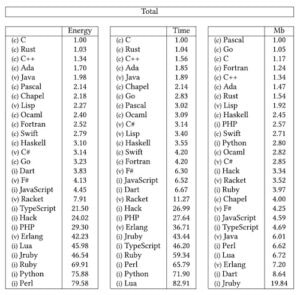
code language table

  • Deploy on green hosting(Scaleway, Infomaniak, AWS Green Region).
  • Use energy-efficient energy-efficient infrastructures with passive cooling or renewable mix.

Governance, culture & process to sustain the Green Coding

Raising team awareness & training

  • Organize Green Code workshops.
  • Create in-house internal software eco-design guides.
  • Learn how to read energy efficiency metrics.
  • Organization of hackathons to generate new ideas and raise awareness among new generations. 


Integrate sustainability criteria into code & ticket reviews

  • Add a carbon impact" criterion in request sweaters.
  • Include an energy performance indicator indicator in technical reviews.
  • Systematize the use of tools like EcoCode during project development.


Set up a "software carbon budget" or consumption KPI

  • Set an energy consumption KPI per component.
  • Monitor CPU/memory consumption before and after refactoring.
  • Establish a "carbon budget" for each software version.


Integrate into the product roadmap/backlog

  • Include sustainable refactoring tasks in the backlog.
  • Plan regular energy audits.
  • Track the progress of software sobriety.
  • Free up the developer's time to attend workshops and conferences on the subject.


Choosing "green" infrastructures & accommodation

  • Opt for data centers powered by renewable energy. (Green Mountain, EvoSwitch, Marilyn)
  • Avoid over-provisioning cloud resources.
  • Automate standby of inactive servers.
  • Don't systematically over-trim your infrastructure.

Measuring impact: metrics & tools for carbon footprint

Green Algorithms for estimating computational footprint

The Green Algorithms model (Lannelongue et al., 2020) evaluates the energy impact of a task according to :

  • Execution time (t),
  • Power consumption (P),
  • Carbon intensity of the energy mix (CI).

Formula: emissions (gCO₂e)=t×P×CI

This model can be used toestimate the energy consumption of a complete algorithm or pipeline.

Let's assume that a server runs a calculation for 10 min (about 0.1667h), that this server consumes 100W (0.1kW) and that its electricity has a carbon intensity of 300 grams of CO₂e/kWh 

Then the formula would be (gCO₂e) = 0.1667 x 0.1 x 300 = 5gCO₂e

This calculation would therefore emit 5g of carbon dioxide.


Direct measurement & internal indicators

  • CPU time per request
  • Average memory consumption 
  • Number of digital and network I/Os
  • Latency and bandwidth 
  • CPU utilization rate
  • Specific tools: oxygenit.io, GreenFrame, WebsiteCarbon.com, ...
  • Firefox's integrated solution to know your consumption in Joules.


Before/after comparisons and longitudinal follow-up 

  • Measuring carbon impact before and after refactoring
  • Calculate energy savings 
  • Integrate these measures into a Green Code dashboard
  • Enhancing the value of Green developments and updates


Limits & precautions

  • Measurements are estimates (dependent on hardware and cloud provider).
  • Always document assumptions: energy mix, average load, runtime.
  • Relative rather than absolute comparisons (before/after optimization).

FAQ - Frequently asked questions about green coding

What is green coding and why is it becoming essential?

Green Coding is a sustainable software development approach aimed at reducing the energy consumption of applications.

It is becoming essential in view of the exponential growth in digital uses and the energy-saving objectives set by companies and public policies, as well as in the face of the multitude of solutions delivered around the world.

How do you measure the carbon footprint of your code?

You can measure your carbon footprint using tools such as EcoCode, GreenFrame, Scaphandre or Green Algorithms. To this can be added the monitoring of CPU, memory and bandwidth consumption metrics, etc. 

Comparing before-and-after results is an easy way to see how much you've saved. 

What are the best green coding practices for developers?

  • Write simple, optimized, low-redundancy code.
  • Reduce unnecessary dependencies and treatments.
  • Optimize network and I/O calls.
  • Regularly measure the code's energy consumption.
What tools and frameworks can help you code in a more eco-responsible way?

A whole range of tools are available these days, including EcoCode (SonarCube extension), Greenframe (web page analysis), Cloud Carbon FootPrint (cloud usage analysis) and more. 

Does green coding have an impact on application performance?

Yes, but more often than not, Green Code has a positive impact on an application's performance. Indeed, optimizing a project for Green Code makes it faster, lighter and less costly to run. Digital sobriety has a very strong link with software performance. 

Image by Nils FRADIN
Nils FRADIN

Technical Consultant and Developer, Expert in the lifecycle of digital solutions

Share this article

Share this article

Contents

Read also

Read the article
Read the article
Read the article