

The day a cosmic ray hacked an Airbus A320
On October 30, 2025, an Airbus A320 operated by JetBlue (flight 2126) suffered an electronic systems failure during a flight between Cancún, Mexico, and Newark, New Jersey. The aircraft, passing through a geomagnetic storm, experienced a sudden uncontrolled descent, forcing the crew to make an emergency landing at Tampa Airport in Florida. This event revealed a critical vulnerability in the Airbus A320's flight control systems: the onboard software proved to be sensitive to solar radiation associated with geomagnetic storms, causing a Single-Event Upset (SEU). The interaction of solar particles with the electronics caused a "bit flip," i.e., the accidental reversal of a bit's state (from 0 to 1 or from 1 to 0), thereby compromising the proper functioning of the systems. Following this incident, Airbus issued an urgent recall on December 1, 2025, affecting approximately 6,000 A320 aircraft worldwide.
How could such an incident have occurred, and more importantly, could it have been prevented? Let's delve into the world of astroparticles to understand their impact on matter, the dangers they pose to our electronic systems, and ways to protect ourselves from them.
Astroparticles
Every second of every day, we are bombarded by thousands of particles invisible to the human eye that pass through our bodies without us realizing it, with energies far higher than those achieved by the largest machines. Discovered by Victor Hess in 1912 during experiments with weather balloons (Nobel Prize in Physics in 1936), these particles are grouped under the name cosmic rays and can be divided into two main categories: those originating from the Sun and carried to Earth by solar winds (electrons, protons, and helium nuclei), and those that are even more energetic, traveling at speeds close to that of light and originating from outside our solar system, called galactic cosmic rays.
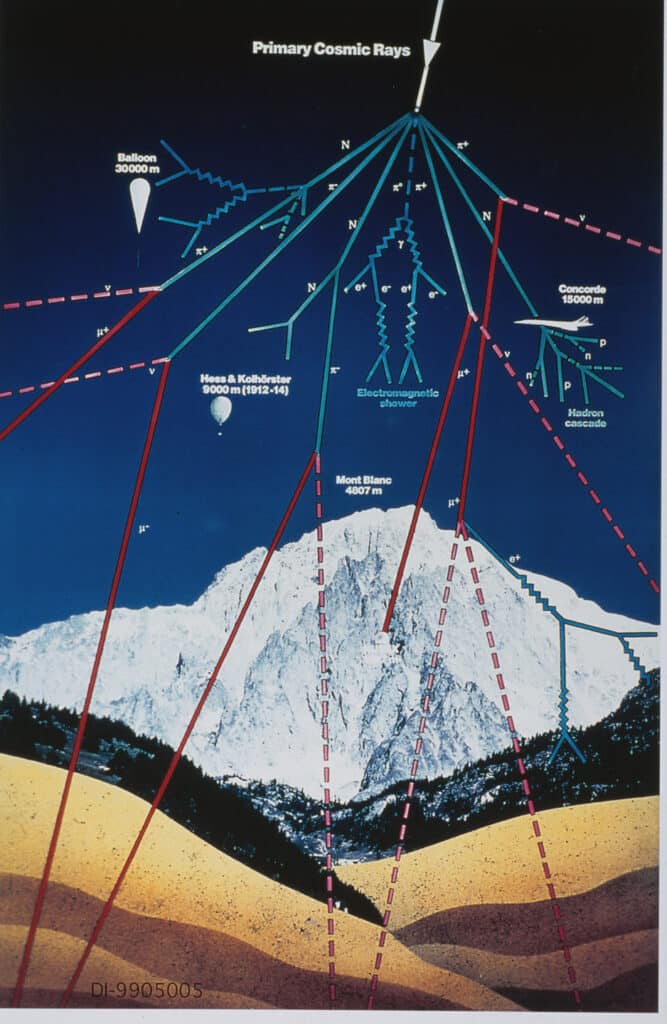
Fig. 1 Interaction of cosmic rays with the atmosphere [Image Credit:: CERN, https://cds.cern.ch/record/2459167]
When they reach Earth, these particles can also collide with those present in the upper atmosphere, generating a veritable "rain" of secondary particles! Approximately 90% of astroparticles are made up of protons, hydrogen nuclei stripped of their electrons, which are the most abundant. But there are also helium nuclei (~9%) and much heavier elements, such as lead, iron, and other elements that form under violent conditions, such as supernovae marking the end of a massive star's life.
Since the solar wind carries many electrically charged particles, it also carries part of the Sun's magnetic field, which disrupts the Earth's magnetic field (Fig. 2). Under normal conditions, the Earth's magnetic field protects us from the solar wind by effectively deflecting it. However, during coronal mass ejections (CMEs), particles can reach speeds up to ten times higher than normal, which is around 300 km/s. The intensity of this radiation increases with altitude and proximity to the magnetic poles, due to the influence of the geomagnetic field on the trajectory of the particles. As a result, the dose of radiation to which we are exposed varies depending on whether we are in a city, in the mountains, or on board an airplane. For example, the radiation dose during a flight is ten times higher than that received in a city!

In the space environment, some of the solar particles are also trapped by the Earth's magnetic field in regions surrounding our planet, called the Van Allen belts, located between 640 and 58,000 km above the surface. These belts also play an essential role in protecting the atmosphere by deflecting energetic particles that would otherwise damage it. However, these belts pose a danger to satellites, which must be equipped with appropriate shielding to protect their sensitive components when they pass through these areas for long periods of time. The same applies to Apollo mission astronauts and all their equipment, which must be protected in order to minimize the amount of radiation they receive.
The Earth's atmosphere, like space, is populated by a multitude of particles which, while protecting us when we are on the surface, can become dangerous when we ascend to high altitudes or venture into space. Therefore, the technology developed for onboard electronics must take all these phenomena into account in order to prevent, as far as possible, any incidents caused by interaction with these particles.
Interaction with matter
During the Airbus A320 flight, the planetary Kp index—which measures the intensity of geomagnetic disturbances on a scale of 0 to 9—reached a value of 5.3, exceeding the threshold for a minor geomagnetic storm. According to the NOAA (National Oceanic and Atmospheric Administration), this type of phenomenon is not uncommon: during an average 11-year solar cycle, the Earth experiences minor geomagnetic storm conditions approximately one day in four. It was precisely this phenomenon that caused the incident on October 30, giving Airbus a kind of aircraft hijacking from outer space! But how could cosmic rays have derailed a software program?
This type of event is not new. In 1979, James Ziegler of IBM, together with W. Lanford of Yale, first explained the mechanism by which a cosmic ray at sea level could cause a Single-Event Upset (SEU) in electronics. Also in 1979, the world's first test on the effects of single events caused by heavy ions was conducted in a particle accelerator at Lawrence Berkeley National Laboratory.

Astroparticles with sufficient energy to strip electrons from atoms or molecules of the matter with which they interact, thereby transforming them into ions, are called ionizing particles, and the process is called ionization. Mathematically, the rate of energy loss E of a particle in matter per unit length x is given by the Bragg curve, described by the following relationship:

where k is a strictly positive real number that depends on the type of ion. As can be seen by integrating the curve in Figure 3, the ionization caused by the particle in matter peaks toward the end of its path, which means that energy loss is greatest at low energies, and that a particle interacting with electronics causes most of the damage at the end of its trajectory, "localizing" ionization in a restricted area. Ionizing particles in cosmic rays fall into two main categories:
- Direct ionization: only heavy ions (atomic number ≥ 2) cause errors in memory circuits via direct ionization, by depositing sufficient charge. Light particles (protons, electrons) are generally not capable of doing this.
- Indirect ionization: Protons and neutrons, although too light to ionize directly, can trigger nuclear reactions (elastic collisions, α/γ particle emissions, spallation) in the semiconductor network. These reactions generate heavy fragments (e.g., Si, C, O nuclei) which, via secondary direct ionization, deposit enough charge to disrupt the circuits.
Uncontrolled exposure to this type of radiation causes interaction with the body's cells, which can lead to DNA damage that, in turn, can promote the development of tumors. However, when properly controlled, these rays can be used for therapeutic purposes, particularly to combat the disease itself. A significant example of this application is hadron therapy, one of the most advanced forms of radiation therapy. This technique uses beams of protons or heavy ions accelerated to high energies and capable of selectively targeting tumor cells. The ions release most of their energy only at the end of their path, allowing the tumor to be irradiated with high precision while preserving the surrounding healthy tissue.
While interaction with biological matter can cause mutations and, in the most serious cases, cancer, in electronics, the impact of a single particle can generate an abnormal signal (Single Event Effect), with potentially critical consequences. In the case of the Airbus A320, a particle compromised the aircraft's safety system. In both cases, the interaction can cause serious effects: on the one hand, biological alterations, and on the other, malfunctions that endanger safety in an aircraft.
Effects on the electronics of the A320
When a charged particle passes through an electronic component, such as those found in aircraft avionics, it can temporarily disrupt the electrical signal, altering the data being carried. If this data relates to flight control software, it can cause a sudden and unintended change in the aircraft's controls.
SEUs are typically caused by dense ionization tracks from high-energy, high-atomic number Z cosmic rays (HZE ions), which are the heavy, highly charged component of galactic cosmic ray (GCR) nuclei.
In the case of the Airbus A320, interaction with cosmic rays corrupted an ELAC (Elevator Aileron Computer), and the A320 has two of them: ELAC1 and ELAC2! Together, they form a cornerstone of Fly-by-Wire (FBW) technology, which the A320 family was the first to adopt. Fly-by-Wire replaces traditional mechanical flight controls with an electronic interface: the pilot's control inputs are converted into electrical signals, processed by flight computers, which then determine how to actuate the control surfaces (ailerons, rudders, stabilizers) to achieve the desired response.
Technology designed to improve the accuracy, efficiency, and safety of modern aircraft can, once corrupted, produce the opposite effect.
Single Event Upset (SEU) mitigation strategies: official solutions (NASA/ESA)
According to NASA, the vulnerability of electronic devices to SEUs has increased due to miniaturization and increased transistor density, despite the reduction in the sensitivity of individual components. The most vulnerable elements include:
- SRAM memories and caches: their compact and fast structure reduces their ability to retain electrical charge, increasing sensitivity to errors.
- Finite state machines and sequential logic: despite the use of larger transistors, which partially reduce their vulnerability, the risk of malfunction persists.
The solutions proposed by NASA and ESA to reduce the probability of SEUs can be divided into software and hardware protections. Software solutions include redundancy and error correction techniques:
- Triple Modular Redundancy (TMR): The main strategy used by NASA and ESA. Three identical copies of the same module operate in parallel, and a majority vote determines the correct output. Very effective for FPGAs and SRAM memories.
- Error Correction Code (ECC): Used to detect and correct single-bit errors in memory. However, for long-term operations, TMR is preferred because ECC cannot handle error accumulation if the corrected data is not rewritten.
Hardware solutions focus on radiation-resistant materials and design:
- Advanced materials: Use of materials such as sapphire or gallium arsenide, which are less sensitive to radiation than silicon.
Hardening techniques to reinforce integrated circuits. - Robust design: Optimization of circuit architecture and use of larger transistors to reduce the probability of SEU (more energy required to change state).
- Localized shielding: Although they cannot completely eliminate SEUs (particle energy too high), they reduce their impact on critical components.
- Watchdog timers and automatic resets: Automatically restart the system in the event of a malfunction, ensuring operational continuity.
Conclusion
What if the sky wasn't just that vast blue (or starry black, for cosmos enthusiasts)... but also an invisible highway where ghost particles play darts with our technologies? By dissecting the adventures of the Airbus A320, we have lifted the veil on the existence of astroparticles: these tiny cosmic adventurers, so discreet that they pass through your body—and your computer screen—without even asking your permission. Yet despite their microscopic size, these cosmic travelers have the power to wreak havoc on the software that makes satellites dance or keeps planes in the air.
"Okay, but my PC doesn't control the International Space Station... So why should I care?" Exactly: imagine this. Tomorrow morning, you turn on your computer, and there... a black screen. No virus, no overheating, no spilled coffee. No: a particle, let's say a muon, has crossed the galaxy like a stray bullet and ended up... in your motherboard. The result? A cosmic bug, as rare as it is unpredictable, that turns your machine into a high-tech paperweight.
(Note to the forgetful: no, "a particle from outer space fried my hard drive" will never be a valid excuse after dropping your employer's computer down the stairs. Sorry.)
Sources
[1] Aerospace Global News, Article link
[2] NASA, “Cosmic Rays” link
[3] Paul E. Dodd et al, “Basic Mechanisms and Modeling of Single-Event Upset in Digital Microelectronics,” IEEE TRANSACTIONS ON NUCLEAR SCIENCE, VOL. 50, NO. 3, 06.2003
[4] D. Binder et al., “Satellite anomalies from galactic cosmic rays,” IEEE TRANSACTIONS ON NUCLEAR SCIENCE, VOL. 22, NO. 6, December 1975.
[5] J. T. Wallmark, “Minimum Size and Maximum Packing Density of Nonredundant Semiconductor Devices,” Proceedings of the IRE, Vol. 50, Issue 3, March 1962.
[6] NASA ETD, “Radiation Effects and Analysis,” link
[7] A. S. Keys, M. D. Watson, “Radiation Hardened Electronics for Extreme Environments,” NASA link
[8] M. Wirthlin et al., “SEU Mitigation and Validation of the LEON3 Soft Processor
Using Triple Modular Redundancy for Space Processing” link
[9] Kliewer, S. (n.d.). Primary cosmic rays. Berkeley Lab.


