


Since 2019, 5 Degrés has been measuring the carbon footprint of its operations every two years to track its progress and refine its action plan. Following the assessments conducted in 2021 and 2023, we are now publishing the results of our third carbon assessment, covering the year 2025.
Background
This carbon footprint assessment was conducted by Carbo, using ADEME’s Bilan Carbone® methodology, as promoted by the Association for Low-Carbon Transition (ABC), covering direct and indirect emissions (Scopes 1, 2, and 3). This is the same methodology used for our previous assessment, which allows for a reliable comparison between the two years.
In 2025, 5 Degrés had 122 employees and generated €14.3 million in revenue, compared with 100 employees and €11.9 million in 2023 (the year of our previous financial report).
The Results of Our 2025 Carbon Footprint Assessment
Our 2025 emissions totaled 167.2 tCO2e, compared with 150 tCO2e in 2023, representing an 11.5% increase in absolute terms. However, this increase is still lower than that of our business over the same period (+22% in headcount, +20% in revenue), reflecting a decrease in our carbon intensity: our emissions are growing more slowly than our business.
| Economic Carbon Intensity | 1.2 tCO2e per 100 k€ in revenue |
| Social Carbon Intensity | 1.4 tCO2e per employee |
Breakdown of our emissions by major category:
Breakdown of 2025 Emissions by Category — Total: 167.2 tCO2e
Breakdown by item:
- Offices/sites (55.5 tCO2e): 74% of this is attributable to meals at work (41.17 tCO2e)—our single-largest source of emissions.
- Operations (47.9 tCO2e): primarily organized events (27.00 tCO2e) and software/telecommunications (20.86 tCO2e).
- Purchases & Services (35.2 tCO2e): services (26.91 tCO2e) and manufactured products (8.24 tCO2e).
- Travel (28.8 tCO2e): commutes (24.74 tCO2e) and business travel (4.01 tCO2e).
- Digital products: virtually zero (0.03 tCO2e).
Transparency Regarding Our Data
We want to be transparent about how these figures are calculated and about their limitations.
- Our report covers our employees on permanent contracts, apprenticeship contracts, and internships during the period. The work performed by our freelancers is not currently included in the calculation, as we do not have reliable data on their activities.
- A portion of our emissions, particularly those related to services (accounting, HR, administrative), is calculated based on monetary ratios (expenditures in euros × ADEME emission factor), rather than on actual data provided by our service providers. This calculation method has a known limitation: our carbon footprint in this category automatically increases with our budget, regardless of the actual impact of our service providers.
- Similarly, the carbon footprint of the events we organize is currently calculated using a standard formula (small/medium/large event × number of participants), without taking into account the venue, mode of transportation, or type of catering.
- Conversely, a significant portion of our data comes directly from our employees through an internal survey on their commuting habits, remote work, videoconferencing, eating habits, and use of artificial intelligence tools. Our assessment could not have been validated without a response rate of at least 50% of our workforce; we reached this threshold, which ensures the reliability of this self-reported data.
Our goal is to refine our data collection year after year, so that our carbon footprint reports reflect the reality of our operations more and more accurately—even when that means questioning a calculation method that, for now, works against us.
Our Action Plan: From 2023 Commitments to the 2030 Pathway
Here, we outline—one lever at a time—the goals set in 2023, what has been accomplished since then (including actions already underway at the time of the previous review), the next concrete step, and the target we are maintaining for 2030.
| Lever | Goal for 2023 | Progress Toward 2025 | Next Action | 2030 Target |
| Digital Tools (SaaS) | Streamline the number of tools and keep total monthly costs under control. | The number of tools has increased (10 → 17), but the total monthly cost has decreased slightly (~13,200 € → ~12,900 €). | Audit of actual usage for each tool to identify duplicate and underutilized licenses. | The target for SaaS revenue remains at -20%. |
| Refurbished Equipment | Increase the proportion of refurbished equipment among new equipment. | The share of refurbished equipment in our new equipment purchases has increased (≈11% in 2023 → ≈15.6% in 2025). For new, non-refurbished purchases, we have also raised our reparability index requirement, which is now above 8/10 (up from ≈7/10 previously). | Give the highest priority to refurbished equipment over any new purchases, and maintain the requirement for a repairability rating of more than 8/10 for any remaining new equipment. | 50% of new purchases to be refurbished products (original target), with a deadline set for the end of 2027 (already disclosed in our 2025 CSR report). |
| Office Supplies | Implement a reuse policy to reduce purchases of office supplies. | Reuse is already practiced on an informal basis, with no quantitative data available to date. Recycled printer paper has been used since 2024. A responsible procurement policy that promotes recycling and reuse has been implemented and communicated. Regular staff awareness training is conducted. | Explore the possibility of switching to refillable supplies (ink cartridges, notepads, markers) to establish a measurable tracking system. Consider purchasing used furniture when necessary. | -30% discount on office supplies remains in effect. |
| Responsible Eating | Expand vegetarian options and raise awareness about sustainable dining. | Since 2024: Monthly plant-based/vegan recipes in our newsletter, a biannual challenge with Ekip (ethical meal vouchers), meat removed from our events, and vegetarian options already in the majority. Regular awareness-raising efforts. Data reported by our employees confirms strong support for flexitarianism: 48.5% already identify as flexitarians (up from 46% in 2023), close to our 50% target. However, the share of takeout meals has increased (31.4% → 42.4%) as much as that of home-cooked meals (19.6% → 28.8%): the goal of cutting takeout in half is therefore not on track. Since the introduction of our Ekip meal voucher card, which incentivizes meals at responsible establishments, the share of our spending at committed businesses has been rising: 5.5% in 2025, 6.6% in the first nine months of 2026 (7.9% in the second quarter). The share of spending at establishments offering vegetarian options has risen from 1.9% to 3.4%, though this does not necessarily mean that a vegetarian dish was consumed. | Establish a system to track the actual rate of flexitarian meals before implementing specific initiatives focused on vegetarian options and homemade meals (e.g., an Ekip survey and/or a biannual internal questionnaire). Measure the impact of our communications (number of views, employee feedback). Focus specifically on reducing takeout meals, rather than relying solely on the growth in homemade meals. | 50% flexitarian meals confirmed; 50% vegetarian and homemade meals—50% maintained as targets, to be reassessed based on monitoring. |
| Office Energy | Reduce the share of natural gas in our facilities' energy consumption. | Paris runs entirely on electricity. Bordeaux will run on electricity (excluding heating) following the move in 2026. Toulouse will continue to use natural gas. All of our electricity contracts are for green electricity, and we turn off the power at night and on weekends. Employee awareness campaigns and posters in our offices. | Reassess the electrification transition in Toulouse once the new site is known (move scheduled for 2027–2028). | The goal is a complete transition, contingent on the future relocation from Toulouse and, in the longer term, from Bordeaux. |
| Sustainable Transportation | Encourage alternatives to private cars for commuting. | A sustainable mobility pass introduced in 2024 (€100/year) and adjusted and converted to a monthly payment starting in 2025 (€25/month in Paris, €15/month in Toulouse and Bordeaux). Regular awareness campaigns. The reported data also show that the share of private car use has increased slightly (17.6% → 19.4%) at the expense of public transportation (54.9% → 49.3%), while cycling and walking have increased (15.7% → 19.4%). Since carpooling is not covered by the flat-rate plan, reported adoption of carpooling is currently zero (0%). | Organize a challenge as part of “May on Bikes” in 2027. Carpooling: Include this initiative in our sustainable mobility package starting in January 2027. | Replace 25% of trips made by private car with public transportation or non-motorized travel. |
| Train vs. Plane | Require that travel between our offices be by train, except in cases of force majeure. | A significant increase since 2023: 80 round-trips between Paris and Toulouse by train versus 2 by plane in 2025 (compared to 40 by train and 7 by plane in 2023). | Maintain the current policy; the existing internal communication is sufficient—no new requirements should be added. | Policy remains unchanged; target is 100% (0 aircraft). |
| Electric Vehicles | Reduce our use of diesel and gasoline vehicles in favor of electric vehicles. | 1 electric vehicle out of a fleet of 4 starting in 2025 (compared to 0 out of 6 in 2023). | Convert the remaining vehicles upon expiration of their lease agreements. Give priority to electric or hybrid ride-hailing vehicles and taxis if necessary; communication plans should be established. Train the drivers of our company-owned vehicles in eco-driving. | A minimum of 50% will be maintained (deadline: end of 2027; already publicly announced, representing 2 out of every 4 vehicles), with the stated goal that the entire fleet will eventually transition to electric vehicles. 50% of ride-hailing and taxi trips will be made using electric or hybrid vehicles. |
| Awareness-raising (workshops) | Train teams on climate issues through dedicated workshops. | In 2024, we reached nearly 40% of our workforce through the “Fresque du Climat” workshops. Unfortunately, these workshops could not be continued in 2025 because the employee who led them had left the company. | Train a new internal team to take over the facilitation of this workshop, and also offer the “2 metric tons” workshop to those who have already participated in the Climate Mural. | The annual workshop program remains a goal, with a target of 100% of employees having attended at least one workshop. |
New initiatives launched in 2025
In addition to these commitments made as early as 2023, our 2025 assessment highlights areas that were not previously addressed, particularly our procurement of services, our events, and our waste. Here’s how we plan to take concrete action on each of these:
- Professional services (accounting, HR, administrative/legal): This item is currently calculated based on our budget, which masks the actual impact of our service providers. We will contact them directly to find out if they already have a carbon footprint assessment and encourage them to conduct one if they do not, in order to replace the budget estimate with actual data and to be able to track a genuine reduction trajectory on their part.
- Organized events: We will systematically document each event (venue, participants’ mode of transportation, type of catering) so that our next assessment will reflect actual figures rather than the current automatic flat rate, which likely overestimates our impact (most of our events are already held near our offices and feature vegetarian catering).
- Organic waste management: The Bokashi composter already in use in Toulouse will be expanded to our Paris locations by the end of 2026, in addition to the cardboard/paper, metal/plastic, glass, and battery sorting already handled by our service providers. In Bordeaux, since we share our office space, we do not have the authority to implement the desired changes, but we plan to begin discussions soon to expand the existing recycling program.
- Ongoing Awareness: Starting in September 2026, we will include quizzes to raise awareness about climate issues in our internal newsletters, using content provided by HelloCarbo.
- Use of artificial intelligence: Our 2025 employee data confirms the scale of the phenomenon, with 98% of respondents already using AI at least once a week, averaging 22 conversations per week. This metric was not measured in 2023, and the rise of generative AI had not yet taken hold in 2025. Its impact on our current report is therefore limited, but will inevitably weigh more heavily on our next report (2027) as usage expands. We have already implemented an internal AI policy; we will now work to raise awareness among our teams about more responsible use (prioritizing the most energy-efficient tools, limiting unnecessary queries, and avoiding redundant uses) in order to anticipate this impact before our next report.
We have deliberately ruled out certain options suggested by our assessment tool, as they were deemed unrealistic or already addressed: reducing our office space (which would conflict with our growing workforce), insulation work and solar panels (out of reach as tenants), reducing our service providers’ budget through in-house operations (this would be a hiring decision, not a CSR lever), switching to a different videoconferencing tool (we’re sticking with Microsoft Teams), expanded remote work (already at the maximum level compatible with our client constraints and our current two days per week), adjusting maintenance services to the actual occupancy of our premises (already utilized to the fullest), reducing our inter-office meetings (we have already streamlined them and taken steps regarding transportation), and offering a cafeteria service on our premises (not feasible given our size).
Our Path Toward 2030
We are maintaining the target set in our previous progress report: to reduce our emissions by 21.57% by 2030 compared to our baseline growth trajectory, representing approximately 82.7 metric tons of CO2e avoided. This is our flagship commitment.
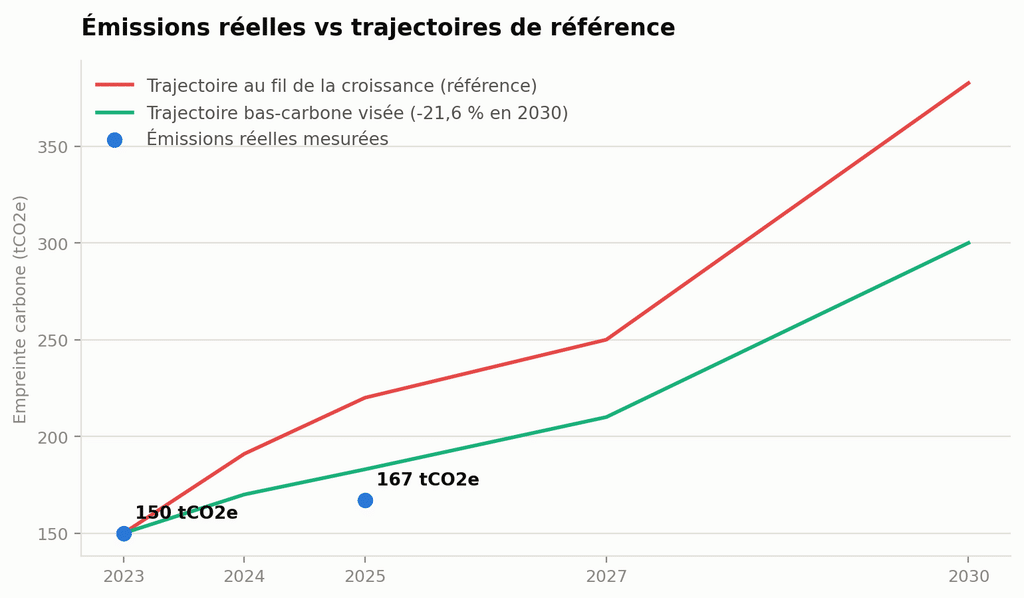
Actual Emissions vs. Reference Trajectories (2023–2030)
This chart calls for an honest assessment. Our baseline projection was based on an assumption of strong growth (130 employees and €12.7 million in revenue in 2024, 169 employees and €16.6 million in 2027). However, our actual growth has been somewhat more moderate than expected: 122 employees in 2025, falling between the 2024 and 2027 milestones initially projected. Our actual emissions (167.2 tCO2e) are currently below our targeted low-carbon trajectory for this period (≈183 tCO2e). This is an encouraging sign, though it must be attributed in part to this slower-than-modeled growth rate, and not solely to the actions we have implemented. It is precisely for this reason that we continue to act on each of the identified levers: our progress must remain secure regardless of our growth rate.
And beyond: a vision for 2035
Our measurement tool (Carbo) now extends its scenarios through 2035, with a more ambitious framework: a low-carbon trajectory targeting a 26% reduction compared to the baseline growth scenario, and a scenario aligned with the Paris Agreement (SBTi 1.5°C) targeting a 64% reduction. These time horizons do not replace our 2030 commitment outlined above, which remains our baseline target, but they provide an idea of the longer-term trajectory we aim to pursue once we have achieved our 2027 milestones (vehicles, refurbished equipment, relocation from Toulouse).
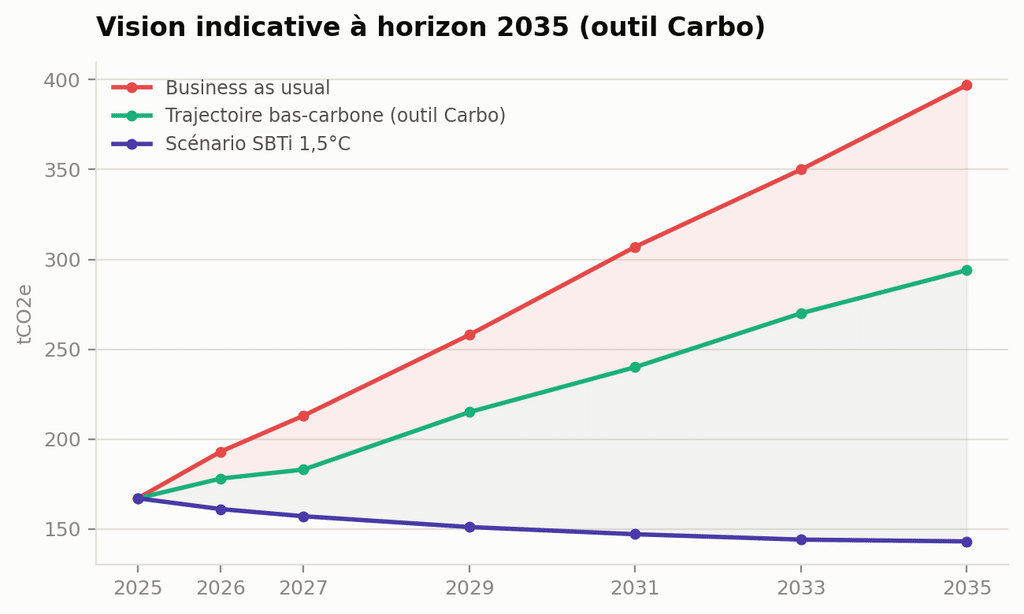
Indicative Outlook for 2035 (approximate values from our Carbo tool)
Conclusion
This third carbon footprint assessment confirms a positive trend, driven by concrete actions related to our business travel and food consumption, while also revealing clear areas for improvement regarding our daily commutes, our equipment, and the quality of our purchasing data. Year after year, we will continue to refine our measurement methods and strengthen our action plan, maintaining the same commitment to transparency.